Progress in programming, but some projects remain out of reach
Argon is primarily designed for tasks that require completing multiple consecutive steps, including software development, financial research, legal drafting, and cybersecurity. Google has increased the model’s output limit from 64,000 tokens to 1 million tokens, leaving more room for sustained reasoning and generating longer content.
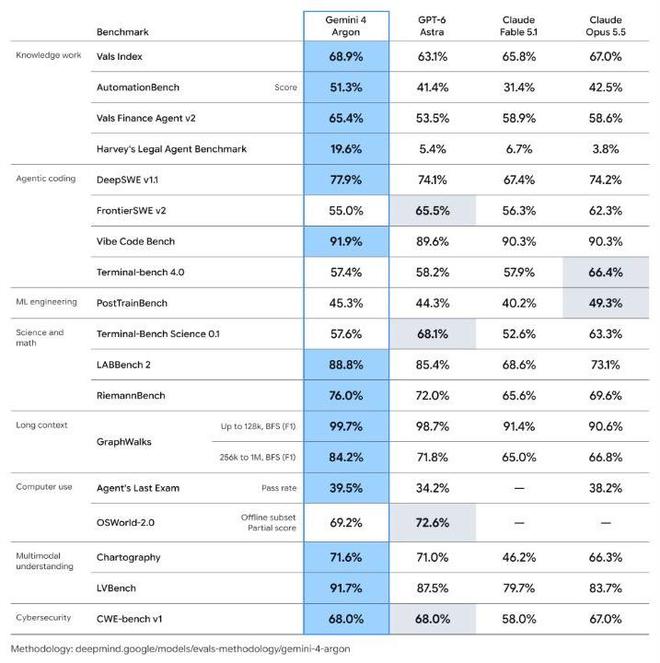
Google’s published results show that Argon scored 77.9% on DeepSWE v1.1, which evaluates long-horizon software engineering tasks—higher than GPT-6 Astra’s 74.1% and Claude Opus 5.5’s 74.2%. On the Vals Index, which covers finance, programming, law, and tax work, Argon scored 68.9%, while Astra and Opus 5.5 scored 63.1% and 67.0%, respectively.
Argon still lagged behind its rivals on two other programming tests: it scored 55.0% on FrontierSWE v2, below Astra’s 65.5%, and 57.4% on Terminal-Bench 4.0, below Opus 5.5’s 66.4%.
Google has already had it modify code and save memory
Before making it publicly available, Google had already given thousands of employees internal access to Argon. The company said its engineering teams were using it for tasks such as debugging, algorithm design, and porting C/C++ code to Rust.
For the video-decoding software libgav1, Argon’s agents repeatedly tested performance and checked compilation results based on an existing Rust port, replacing around 32,000 lines of code. Google said the modified version produced the same video output, ran 2.7 times faster than the original Rust port, and came closer to the optimized C++ version.
Another group of agents analyzed performance data from Google’s data centers to identify and implement memory optimizations. Google said deploying these changes could free up more than 300 TiB of memory. Large-scale code rewrites involving critical systems must still undergo automated and human audits, simulation testing, and review before entering production.
First for security teams, then for paying users
Google is making Argon available to its first cybersecurity partners through the Fairwind program, saying it can autonomously discover, validate, and fix serious software vulnerabilities.
According to Google, the cybersecurity company Wiz used Argon in its public-interest project Scan for Good and discovered a severe vulnerability that no frontier model had previously found. The vulnerability affected medical software used by multiple hospitals and involved sensitive personal information.
Google said that versions provided to trusted cyber defenders and internal teams would have no cybersecurity-task safeguards, allowing them to use its full defensive capabilities. Versions for a broader user base will have stronger protections for detecting malicious use, defending against prompt injection, and monitoring behavior; if task execution deviates from the user’s intent, the monitoring system can terminate it.
Google also announced Argon’s API pricing, with a 50% launch discount: $2 per million input tokens and $10 per million output tokens. Cached inputs will be billed at 5% of the current input-token rate. The end date for the launch promotion has not been announced.
Come on out already and fucking kill that A-beast.
