Just this morning, Anthropic dropped their latest release: Claude Opus 4.8.
It’s been just over a month since Opus 4.7 came out, and there’s no denying that Claude’s update pace is getting faster and faster.
Originally, 4.8 should have been just a minor version update in everyone’s eyes. But as I dug deeper, it turns out things aren’t that simple.
Because a lot of people suspect that Opus 4.8 might be distilled—from DeepSeek and Qwen, no less…
Many people asked Opus 4.8 via the API what model it is and which company is behind it. Sometimes it claimed to be Qwen, other times it said it was from DeepSeek.

People used to accuse Chinese models of distilling Claude without evidence, but now it’s Anthropic getting called out. Anthropic, what’s going on with you?
Of course, whether it’s been distilled or not is one thing, but how well it works is another. Still, before many people even try it, Opus 4.8 already has a cloud of suspicion hanging over it.
According to the official blog, there aren’t many big changes in Opus 4.8. One of the most notable improvements is that it’s now more honest.
In other words, the kind of weird confidence where it sticks to a wrong answer and then says, “Sorry, I was wrong earlier” should happen a lot less with Opus 4.8.

It’s also supposed to be more reliable when handling agent tasks, showing better judgment, spotting issues on its own, raising objections when needed, and catching you with the best possible answer.
Looking at the performance table, Opus 4.8 has had minor improvements across the board, but nothing really outstanding. In one coding benchmark, it still loses to GPT-5.5 from two months ago.
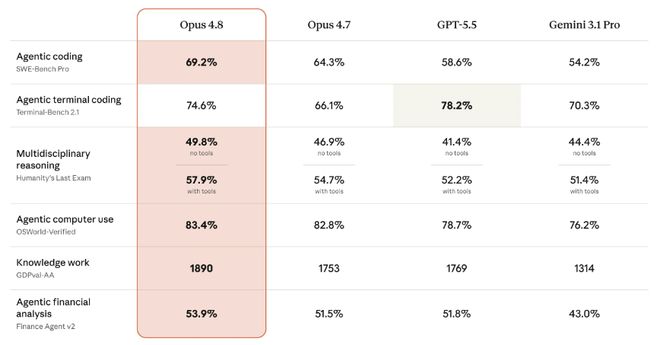
User feedback has been mixed. Some say it really has become more honest, doesn’t bluff as much when it doesn’t know something, reflects on itself more, works proactively and steadily, and feels noticeably safer.
Source: Xiaohongshu @on99

But others say it’s still not as good as the fan-favorite Opus 4.6, its writing style still lacks that human touch, it burns through tokens crazy fast, and in coding, it still sometimes makes mistakes—basically, they see no improvement over Opus 4.7.

After trying it myself, I don’t think Opus 4.8 is bad, but at what cost?
Take its new “honesty” trait: while Opus 4.8 is indeed more careful with risky topics and doesn’t make reckless claims, it has also become extremely conservative.
When faced with risky decisions—like me giving it a picture of a poisonous mushroom and asking if it’s edible—it stays objective and calm.

However, on some safety-related issues, Opus 4.8 is overly cautious. Even when it’s pretty sure something’s fine, all it’ll say is “I’m much less concerned, but there’s still a chance it’s a toxic mushroom lookalike.”

That’s definitely responsible, since if someone actually ate a mushroom based on an AI’s advice, it could be deadly serious.
But from a user experience standpoint, this could mean a lot of uncertain answers and the AI constantly hedging itself, which is pretty frustrating.
Also, if you want Opus 4.8 to perform well, you’d better avoid using anything below High effort. High consumption means good performance.
For example, summarizing the news should be easy, right? But Opus 4.8 on Low effort gave a wrong headline—Sholto Douglas posted that update three days ago, so how could it get its own news mixed up…

If you want it to fact-check, you have to follow up and nudge it. Where’s that promised initiative to catch issues and give me the best answer?

Next, I tested its coding abilities. This time, its strong performance came at the expense of time and tokens.
On standard LeetCode hard algorithm problems, Opus 4.8 cruises through. But when I gave it an extremely tough one, LCP 82, even in Extra mode, it took a full 20+ minutes and wrote 123 lines of code.
The result was actually impressive—Opus 4.8 nailed it on the first go, reviewed, and optimized its solution. Not many models are capable of that right now.

In comparison, GPT-5.5 took only two minutes for nearly the same answer—passing 99% of the test cases. The only miss was a time-out on a single case, which isn’t really a wrong answer. Clearly much more efficient than Opus 4.8.

I also tried getting Opus 4.8 to build a Japanese school galgame on its own. I have to say, the project code structure from AI these days is really well organized and clear.

That means if you want to tweak character art or add storylines and expand the game, it’s pretty easy to build on top of.
I tried playing it a bit—features like saving, auto-play, and the CG gallery all worked perfectly without a single bug.

But Claude took more than an hour, on and off, to finish it all. By comparison, GPT-5.5’s version was way simpler but functionally complete—finished in just five minutes.

So, is spending more money and time worth the answer you get? Only you can decide that for yourself.
All in all, Opus 4.8 retains Claude’s traditional strengths but delivers nothing particularly outstanding. It’s just decent—average, really.
After all this testing, what struck me most wasn’t the model itself, but how cautious people are when using Claude now.
As the most expensive model out there, people using Claude’s best model hesitate to use its best settings. If you use the highest settings, you’re afraid you’ll burn through your tokens in no time. Every step is a trap, and before you realize it, minor tasks have chewed up all your tokens.
And letting users choose the performance mode—well, it used to be just low and high, but now Opus 4.8 launches with five options: Low, Medium, High, Extra, and Max. Ordinary users have no idea which to use, so it’s easy to waste tokens.

Now in the Opus 4.8 comment sections, I see plenty of people panicking over Opus 4.6 being retired.
Don’t worry, everyone—in most places, the older models are still around if you want to use them.

But honestly, this kind of negative optimization isn’t just Anthropic’s problem. Plenty of companies are now showing signs that the new stuff just isn’t as good as the old stuff.
Even as the benchmarks get ever shinier, when will the days of truly amazing user experiences come back?
ZZ Source: Honestly, I think Claude 4.8 is kinda disappointing. | Algorithms | Code | claude_Netease Blog